
Saved By the Truth to Live By the Truth
11/19/2017
GR 2104
Galatians 5:7-12

Gil Rugh


Transcript
GR 210411/19/2017
Saved by the Truth to Live by the Truth
Galatians 5:7-12
Gil Rugh
We’re in the Book of Galatians in your bibles together, the Book of Galatians. Paul is dealing with the subject that is of greatest importance, the gospel. What is the gospel? If we are not clear on the gospel, what do we have? What is the message that we preach? If we have a corrupted gospel, a gospel that has been altered or changed, everything else becomes irrelevant. That’s because the gospel is the power of God for salvation to everyone who believes. But, if they’re believing a false gospel, a gospel that has been corrupted so that it has no power for salvation, everything else we are doing is really a waste of time and leading people astray. So the Book of Galatians is bringing a message that is of great importance.
The problem is, the devil is the relentless opposer of the gospel of Jesus Christ, and Paul’s dealing with what are perhaps his most effective tools, and that is infiltrating among believers, with those who are not believers, but know the truth, but are corrupting the truth, and that’s what’s happening in the Galatian churches. Those we call Judaizers, Jews that have the benefit of a thorough background in the Old Testament, who have been exposed to the truth of Christ, made a profession of that truth, but are mixing the truth of the gospel, with the requirements of the Mosaic Law. Paul says that’s a disaster. Those who are doing it have never really trusted in the grace of God, providing salvation in Christ alone, so he started out this letter by saying they were anathema, cursed to hell. It’s an ongoing problem.
Peter, remember in his second letter in chapter two said “just as there were false prophets among the people in Israel, there will also be false teachers among you.” Now note that….there will be false teachers among you. Remember the false prophets in the Old Testament came proclaiming they were the genuine ones, so these false teachers among believers in the churches come corrupting the truth, steering people away from the truth, and it ultimately involved even denying the Master who bought them and they will bring swift destruction upon themselves. Very similar to what Paul’s saying in the section before us in Galatians chapter five.
We’ve looked through the first six verses. Let me just review with you what he covered in those. He started out by reminding us; Christ redeemed us for a life of freedom. Chapter 5 verse one, “it was for freedom that Christ set us free.” There is true freedom in Christ so that’s why He died to set us free, to do for us what we could not do for ourselves.
Secondly, we must stand firm in our freedom, therefore “keep standing firm” in that freedom. You don’t go back to slavery, you don’t go back to law, you don’t go back to man’s works, attempting to accomplish for yourself what only God could do for us. I couldn’t earn righteousness, I couldn’t merit it. I was a person under condemnation. All the law could do was enslave. No problem with the Law, it could require perfection, but man has no ability to live a perfect life.
Thirdly, salvation is secured by faith alone, so verse two said, “behold, I Paul, say to you that if you receive circumcision, Christ will be of no benefit to you.” We’ll talk more about this as we move along in our study this evening, but what he is saying is, if you mix your works with the message of Christ, you’ve cancelled out what Christ has done. That’s the deceptive thing. We sometimes look at people and as long as they agree with us on the facts of the gospel we’ll say well that’s good enough, but when you mix man’s works, even works like the Mosaic Law that are a part of Scripture but never were a way of salvation, you in effect have given the antidote to God’s power.
That’s the devil’s trickery. “He masquerades as an angel of light” as 2 Corinthians 11 says, and agrees, O yes, Christ was the Son of—He died on the cross, He was raised from the dead, you have to trust Him, but that alone won’t save you. That’s what he’s saying in verse two, if you receive circumcision, not that circumcision is anything, we’ll talk about that further, but if you add that, thinking that’s part of what saves you, you’ve cancelled out the work of Christ. You can’t mix it. It is secured by faith alone.
Number four you cannot submit to only part of the law. If you are trying to break out parts of the Law and we’ve belabored this because it is confusing to people today. We talked about Reformed Theology. I read you some quotes even from those who are dispensational that they try to break off a piece of the Law, and say we’re obligated to part of the Law. His argument here is if you try to make any part of the Law obligatory for your salvation, you’ve nullified God’s work. You’ve obligated yourself to the whole Law.
Remember James? We’ve talked about if you break one part of the Law; you’ve broken the whole thing. People say, “well we don’t keep the ceremonial law, we keep the moral part of the law.” The law is a unit. That doesn’t mean there is nothing in the Law that is not obligatory for us as believers today, but we do it not because it’s part of the Law, but because the truth given to the church gives us certain responsibilities as well. We don’t earn our salvation by doing this, so important you cannot submit to only part of the Law, either you are under the Mosaic Law, or you are not under the Mosaic Law. You can’t break it out into pieces.
Number 5, justification is “by grace alone through faith alone” in verse four. You’ve been severed from Christ, you who are seeking to be justified by Law. You’ve fallen from grace. You’ve turned from the grace way of salvation to the law way of salvation. If you seek to be justified by the Law then you have fallen from grace. It doesn’t mean they lost their salvation; remember it means they are not on a grace way of salvation. This is what the Protestant Reformation was about. It’s still the major difference between us as Evangelical Christians and, for example, Roman Catholicism and really the rest of Protestantism to large extent as well. Salvation is by grace alone through faith alone. If it’s by works, it is no longer by grace! Paul dealt with that in Romans as well.
Number six we live through the Spirit by faith, waiting for the hope in verse five, for we through the Spirit, by faith, are waiting for the hope of righteousness. We’re going to talk further about this. Salvation begins when we place our faith in Christ but now that we’ve placed our faith in Christ, we don’t live a life of works, we live by faith. It began by the work of the Spirit in our hearts, it continues by that work, and we continue living by faith in what Christ provided, and the work of the Spirit in and through us.
Number seven, external rights do not affect our blessings in Christ, in verse six and what we talked about, about this, circumcision or uncircumcision is not an issue. It doesn’t make you more acceptable; it doesn’t make you less acceptable. It’s when you make that part of what is required for salvation as we’re going to see also for sanctification, that’s the problem, but some things are neither plus nor minus. Paul dealt with this in his letter to the Corinthians as well. If you’re circumcised it’s nothing, if you’re not circumcised it’s nothing. Sometimes problems come when we develop personal convictions about something and then we try to move those personal convictions over into requirements. There are things you can decide to do or not to do, but when you make those a requirement for salvation or a requirement for the Spirit to carry out His work of sanctification, then you’ve corrupted the truth.
We preachers are great for that. I haven’t been called to preach my personal convictions. I’ve been called to preach the word of God and that’s true for the church. I can have my personal convictions, you can have your personal convictions, but this church is not to be about personal convictions, it’s about the truth of what God’s word is. That doesn’t mean that there can’t be things that we set up but they’re not part of salvation, they’re just what we do. We meet at ten o’clock on Sunday morning. That’s not a requirement for salvation it’s not a requirement for sanctification, it’s just something that we’ve set up that is good. Well oh, you’re legalistic. I’ve shared with you many years ago we put parking lot signs up. We had some people in an uproar. You’re getting legalistic because we tell you where to park your car. It had nothing to do with your salvation, nothing to do with your sanctification except when you lose your temper over the sign, then it’s a problem.
Number eight, justifying faith produces love in our lives. There is a result that affects our conduct. The character of God is going to be produced in us and true saving faith produces love in our lives, verse six, “faith working through love,” so we’re ready to look into verse seven. In this section as we noted when we come into chapter five, sometimes we break it down into three sections for convenience where Paul did his personal defense and his doctrinal presentation, and now his application of the truth that will encompass a lot of chapter five and chapter six. He also picks up what he has talked about as we’ve seen already, and verses 7 to 12 where we’re going to focus our attention, it’ll be very similar to chapter four verses 12 to 20 which is more personal.
We noted that Paul becomes more personal and warm addressing them in chapter four verse 12. “I beg of you, brethren,” and he talks about his heart for them, the relationship they have, how God worked in his life and their life as they ministered together when he was with them. When we pick up with verse seven in chapter 5 you see more of that personal connection of Paul with them, and the concern, and it’s a genuine concern, “you were running well; who hindered you from obeying the truth?” You know Paul’s fond of his athletic kind of metaphors and he’s complimenting them, and he’s concerned for them. These are his spiritual family. You were doing so well. You were running the race well.
Paul often refers to his own Christian experience in service of the Lord as a race that he’s running. Come back to Acts chapter 20 verse 24, “but I do not consider my life of any account as dear to myself, so that I may finish my course.” You see that picture. This is my course. It’s like he is a runner in a race. I am not worried about myself. My concern is finishing this race well “that I might finish my course and the ministry, which I received from the Lord Jesus, to testify solemnly of the gospel of the grace of God.” I want to be faithful to the end. I want to finish well!
Over in 2 Timothy chapter four verse seven, a passage we read in an earlier study today. Paul says that “I have finished the course, I have kept the faith, henceforth there’s a crown of righteousness laid up for me,” same kind as he looks on his life now at the closing period. “I’ve finished the course,” best as I could before the Lord I ran well, and I look forward to the reward at the end of the race, so when you come back to Galatians chapter five you see something of Paul’s personal confidence in the reality of the Galatians salvation. You were running well. They responded to the gospel when Paul preached. They hit the ground running so to speak. You know Paul’s been gone for a little bit of time now but you know what he has heard has been good but now some things have happened. “Who hindered you from obeying the truth?” Something has come in they were hindered.
Back in chapter three, verse one, “you foolish Galatians, who has bewitched you?” It was like somebody put them under a spell. Now he changes the analogy but the same idea over in chapter five verse seven. “You were running well; who hindered you?” You’re in the race, now who put obstacles in your way that slowed you down, that is, turned you off the course that is, cut in, so you’re not running like you were? Something is impacting the Galatians from obeying the truth, in that present tense here, a present infinitive is; their progress is being hindered. What has come in? You know you’re running the race, you have your eyes on the goal, something cuts in, obstacles are put along the way, and now your consistency with the truth is being hindered. The truth is the truth of the gospel in Christ.
Back in chapter two verse five. You see Paul picking up elements of what he talked about, chapter two verse five, “but we did not yield in subjection to them even for an hour, so that the truth of the gospel would remain with you.” There he talked about in verse four, “false brethren who had sneaked in secretly to spy out our liberty in Christ. We didn’t yield in subjection to them even for a brief time, so the truth of the gospel would remain with you,” but now these same kind of false brethren have cut in on them, and are turning them aside from obeying the gospel. The very thing Paul had said he had to stand firm with and stay true to, they are being turned away from obeying the truth, the truth that’s provided in Christ and in Him alone.
You note here, the truth is not just something believed when you’re saved. Oh I placed my faith in Christ. That’s great, that is the beginning of a life of faith. That is the point. Remember back in chapter three again, following what we read just a moment ago. “Who has bewitched you” verse one, “this is the only thing” verse two “I want to find out from you: did you receive the Spirit by the works of the Law, or by hearing of faith?” Go back to when you were saved. Well I placed my faith in Christ. Verse 3, “are you so foolish? Having begun by the Spirit are you now being perfected by the flesh?” Now you’re turning away from faith in Christ as your way of life, to what, you’re going to go back, you’re going to turn away now and try to say I’m going to put myself under the Law, so you’re saved by faith and kept by the Law, sanctified by Law.
That’s what’s going on here; you’re no longer obeying the truth. That’s something to be lived out; we live a life of faith now. This is a disaster, that aspect of Reformed Theology that we’re under the Law and I read you a quote from that in our previous study, as the way of sanctification. That is just as corrupt as making it a way of justification. Now you’re going back under the Law, a way of slavery, to live the Christian life, that’s Paul’s point. You were running well. You received the Spirit by faith. Now you think God’s way of perfecting you is putting you under the Law that keeps you from obeying the truth. The truth that you believed is now to be lived out, day by day.
You know Habakkuk 2:4, “the just shall live by faith.” Paul quoted that in Romans chapter one verse 17. He quoted it in chapter three of Galatians. Turn back to Galatians 3 and in Galatians 3, a great chapter, it took us back to Abraham remember, and he “believed God and God declared him righteous.” In chapter, three verse 11, “now that no one is justified by the Law before God is evident for the righteous man shall live by faith.” That’s quoting Habakkuk, but the point is we enter into life by faith and that is the beginning of a life of faith. The life of a believer is a life of faith. What is a believer? One who has his faith in Christ and the work that He is doing and has provided? It doesn’t mean that we are not truly saved. How else do you explain it? It’s a new life. This whole idea of putting people under works. Now come over to Hebrews chapter 10. This is another place where Habakkuk 2:4 is quoted, “the just shall live by faith.”
Sometimes you read commentators and they’ll say, “well this might be talking about our initial salvation, but other times it seems it’s talking about the life we live, and they are inseparable. I placed my faith in Christ when I first trusted Him by God’s grace but I have continued to live my life now by trust in Him and His word.” Hebrews chapter 10, we want to pick up for the context here with verse 36. He’s trying to encourage the Hebrew believers here because they’re under pressure and part of the pressure is for them to go back to the Mosaic Law. Look at verse 36. “For you have need of endurance, so that when you have done the will of God, you may receive what was promised.” Like Paul talked about, “I finished my course, I’ve kept the faith, henceforth there’s laid up for me a crown of righteousness,” so that need of endurance, that’s talking about staying with it .
In verse, 32 he had told them, “remember the former days, when after being enlightened, you trusted Christ, and your spiritual eyes were opened. You endured all kinds of suffering and suffered great loss.” Verse 35, “therefore don’t throw away your confidence, you have need of endurance,” verse 36, “so that when you’ve done the will of God, you may receive what was promised. For yet in a very little while, He who is coming will come, and will not delay but my righteous one shall live by faith.” You see, in the context here that he’s using that verse from Habakkuk 2:4, in the context of keeping on.
“My righteous one shall live by faith; if he shrinks back, My soul has no pleasure in him.” This is Paul’s concern for the Galatians, if they continue on, and the course that they are being turned to, it will indicate they have no relationship truly with God as he referred to earlier in the letter to the Galatians. Perhaps my work, I’m afraid that maybe I labored with you in vain, their salvation wasn’t genuine. My soul has no pleasure in him but we are not of those who shrink back to destruction, but to those who have faith to the preserving of the soul. We have that ongoing faith; the manifestation of the genuineness of our faith in Christ is what? We continue, we persevere, we endure and, quite frankly, those that don’t endure manifest that their faith never was a saving faith. That’s the point, verse 38, “My righteous one shall live by faith.” You see that the one who has become righteous by faith will live by faith, and those who shrink back turn away, God says My soul has no pleasure in them.
The only choice is for you to continue on or you go back to destruction. I was talking with someone in the last week or so and I shared with them about a person that I know rather well. I said, as far as I can tell they had an emotional conversion but not a true heart conversion, a true saving experience because they’ve gone back. Something’s wrong if he shrinks back so you see the seriousness of it. It’s the same in this letter to the Hebrews; they’re talking about going back to the Law, that’ll take the pressure off. The Jews won’t be persecuting us Hebrew Christians any longer but we can have the best of both worlds; we know about Christ and we keep the Law and everybody’s happy, but God is not pleased and his children can’t do it. As Aaron shared in the song we sang, that person had endurance. Where did it come from? Well he was exceptional. He is, but believers are exceptional by God’s grace. Weak as we are, frail as we are in ourselves, we have the Spirit of God and His grace enables us.
What is being manifest when people who won’t follow through is that they don’t really trust the Lord. Isn’t that what comes? Well I don’t trust Him, and these false teachers seem to have something I can trust, I’ll trust them. I can’t trust the truth and trust the false teaching as well. Come back to Galatians chapter five. These can be difficult words. You know all of us want our kids to be saved and we hope for the best and sometimes we hold onto, well they made their profession. They’re living for the world now. You know I want to be honest with them. I know you made a profession but your life denies what you professed. Your profession wasn’t true because your life wasn’t changed.
It’s not a matter, well I made a profession, now whatever I do with my life is irrelevant. “If any man be in Christ he’s a new creation, a new creature, the old things pass away new things come,” and I don’t want to give them confidence in anything other than the Word. Not to be mean, I want more than anything for my kids and my grandkids to be saved, but when they are saved, their life will change, and they’ll be an endurance in that change. That doesn’t mean there won’t be stumbles. Every time they fail I don’t want to say, oh you’re probably not saved. If that were the case, none of us would be saved. We do stumble.
Paul’s concern for the Galatians, come back to chapter five, they were running well who hindered them? He just wants to pull them back on track, so you were running well, Galatians 5:7, “who hindered you from obeying the truth” and here’s what’s important. This persuasion did not come from Him who calls you, that call of God to salvation, these Judaizers with their mixture of truth and error. This is not God speaking to you. That’s serious, as I mentioned to you and said, if you start listening to the devil through people he is using, you will soon find yourself confused and moving off the track. That’s what’s happened here; this persuasion did not come from Him who calls you. It doesn’t come from God. These spokesmen, these teachers, are not teaching you truth, and God cannot lie, so we know it’s a corruption from the devil.
Well I think they’re genuine, that’s why we measure it in light of the truth. It’s what Paul says he preached the truth, “the gospel I preached to you,” is God’s word. I got it from God, that means those who are teaching something else are teaching in error, and we don’t want to try to find excuses to believe and accept error. Now for us we have the completed word of God, “Jesus said, ‘Your word is truth’” and John talks about this in his epistles; this is the standard by which truth is known so this does not come from the One who calls you, it was God who called you. That’s why he started out in chapter one verse six. “I am amazed that you are so quickly deserting Him who called you, by the grace of Christ for a different gospel.” Then it’s one of a different kind, not related to Mine at all, but some who are disturbing you want to distort the gospel of Christ, and you see the corruption comes in gradually, and well we can accept it, we can adjust.
It’s good to be broader. We don’t want to be viewed as the narrow ones who think we’re the only ones who are right. I don’t think we’re the only ones who are right, we think God is the only One who is right and so our commitment is to His word. We’re not being kind, loving, and understanding when we’ll compromise the Word to get along with people, so chapter five, verse nine, “a little leaven leavens the whole lump.” Well that principal, the analogy is with leaven, what does leaven do? Like the yeast you put in. Marilyn used to make sour dough bread and she had a starter. What’s a starter? Well you get it from someone and it’s that yeast or whatever, don’t hold me tightly to talking about cooking but I put milk on my cereal. If it involves heat, I don’t--well I make oats every morning. I put my oats in the microwave, with water and I have breakfast so I do cook but the yeast, the leaven it permeates, it spreads, and that’s the analogy. A little leaven leavens the whole lump so that’s the point here. Error is like leaven, it spreads.
You know it’s hard to keep the church on track with truth. Somehow, leaven comes in, lies come in, error comes in and it’s just that relentless battle to stay faithful to truth, and what has been the history of the church? It is that constant move away from truth, sometimes subtly sometimes gradually. These Galatians didn’t even know evidently, they’re off track, so Paul says, somebody put you under a spell? What’s going on? You were running well? They think they’re doing okay, that’s why what the devil does is move us as his people away from a serious commitment to truth, which involves the work of studying the word so we know it well enough to recognize that which is in conflict with it. When you start talking to people who have general knowledge of the Scripture and yeah, you know, I think they’re believers but they don’t seem to know a lot.
Quite frankly, I’ve met believers over the years, sit and talk with them and their testimony is clear but boy it seems like they know so little about the word of God, having been believers for so long. What have we been doing? We go to churches and we want to get twenty minutes of something that encourages me and challenges me and helps me know what’ll make me a better parent, a better husband, a better wife, do better at work and we’re on our way and we think, “oh boy it’s great being a believer.” How do we know error?
Reading about a church, now they’re putting women in positions as teachers and they’re happy with that and they think they’re showing progress and we’ve come to a clear…. What about what the word of God says about this? Is this really consistent with the word of God? How do we just begin to move? Well, the start is, how well do we know the truth? If you don’t know the truth very well, how are you going to know when the devil brings his subtly in, remember he can quote the Scriptures. Remember the temptation of Christ in Matthew, when Christ quotes Scripture, the devil can quote it back. Well, I guess you’ve a point there. But, he says you don’t have a point, here’s what the Scripture says. We have to know the Scripture so well inside and out, that’s why it works. We come and say, oh gee…ah…well, we have to apply ourselves.
Okay, “a little leaven leavens the whole lump.” You let a little bit in--we’ve had our doctrinal conflicts and other conflicts. We have to deal with it. What is the truth here? And we see, over the years we had issues over mixing psychology and Scripture and dealt with a man who had great influence, had influence in the seminary I attended and destroyed it. You can’t have nothing but the Scripture if you’re going to help people, and seminary professors were led astray. Now it’s an accepted thing; you have to have counseling programs, people who’ve been trained in counseling or how are people going to deal with the serious problems, as though the word of God is good, but when you’ve really got serious issues you need the world. We mix that in, stir it up with “good intentions” and we end up, the word is corrupted, we move on, and the church is more concerned about teaching people about the practicality of life, than they are about the truth of God. A little leaven leavens the whole lump, so you keep the little bit of leaven out, it doesn’t spread, is the analogy.
These Galatians somehow don’t realize how serious this matter really is, but Paul, he hasn’t given up hope. Verse 10, “I have confidence in you in the Lord. I have confidence in you, in your own strength and your ability. I have confidence in you In the Lord,” and that goes back to Paul’s confidence that they really have trusted Christ. Now he’s not sure of every one of them, he’s expressed that. It comes out, he’s warned them. Verse four, “those who are really committed to this Law-gospel relationship are cut off from the salvation in Christ, but I have confidence in you in the Lord, you will adopt no other view.” If I’m dealing with true believers here, you will stay faithful to the truth.
Let me read a quote. I was going to leave it out with Luther, but since these are days we talk about the Reformation because of the 500th anniversary, he wrote a great commentary on the Book of Galatians. It’s been reprinted; you can pick it up. It’s interesting to read someone from 500 years ago but a faithful commitment to the word doesn’t go out of date. Here’s what he said particularly about; he’s writing about this passage in Galatians but about leaven and how it spreads. “To tolerate a trifling error inevitably leads to crass heresy. The doctrine of the bible is not ours to take or to allow liberties with, we have no right to change even a little of it. Let others praise charity and concord to the skies. We magnify the authority of the word and faith. Charity may be neglected at times, without peril, but not the word and faith. When it comes to faith in salvation in the midst of lies and errors that parade as truth and deceive many, charity has no voice or vote. Let us not be influenced by the popular cry for charity and unity. If we do not love God and His word, what difference does it make if we love anything at all?”
Aren’t we glad there were men who called the church back to truth, and we want to be in that line? It is a constant battle. It is relentless. I shared with you, I was reading a man who’s now with the Lord. His book was written about 2000, that was 18 years ago. He says. “I’m deeply concerned by the loss of interest in serious bible study in evangelical churches,” and I say that’s my concern as well. I’m not saying we’re the only church that’s teaching the word but I am concerned; there seems to be a seriously diminished interest. He noted as I observed with you that seemed to peak in the 60’s and 70’s into the early 80’s and then there just seemed to be that decline and interest in serious study of God’s word, so come to Galatians 5.
“I have confidence in you in the Lord.” My confidence is a settled confidence. That’s a perfect tense, it denotes something that comes in the past and is true to this day, so Paul, with all that he is saying tells these churches, I do have confidence in you. My confidence remains a settled confidence in you, in the Lord “that you will adopt no other view” and because he’s confident, I really believe that you trusted Christ. I’m just correcting you and if you’ve really trusted Christ when you’re confronted with the truth and the error that’s being presented, true Christians have spiritual insight. The unbeliever has no insight. He’s blind to the truth. He’s in darkness. That’s the danger when false teachers come in. I’ve shared with you we have them in our evangelical seminaries and they can talk about the truth inside and out but they are corrupting the truth.
It’s true of the man that I used as that example from the seminary that I graduated. When error gets in, it has a way of spreading, getting a hold, but true believers perceive the truth but they end up losing the battle, as far as rescuing the seminary and it happens to churches. The church moves over, but the churches that have continued with names of those from their history, whether it’s Luther, Calvin, or Wesley, so many of them. I was a Methodist but I didn’t hear the gospel of salvation nor did my parents in that Methodist church, it didn’t preach the same gospel that Wesley preached.
That’s the pattern, “but I have confidence in you in the Lord, you will adopt no other view.” In spite of his concern and the severity of his language, it’s like severe discipline for your children, it is for their good and Paul’s confident that these genuine believers will hold to the truth, and his confidence is in the Lord. He doesn’t let His children go. Philippians 1:6, “I am confident of this very thing that He who began a good work in you will continue to bring it to perfection until the day of Christ Jesus.” His confidence is in the Lord.
Those who abandon the truth reveal they never belonged to the Lord. That doesn’t mean true believers can’t get off track. The Galatians are getting off track, but believers can’t stay off track when they depart from the word. That’s what discipline does, the discipline of the Lord, sometimes exercised by the body as the Lord’s representative and sometimes the Lord intervenes and sometimes as he did with some in the Corinthian church, He takes their life. They were believers; Paul refers to them as believers. “Some of you sleep,” the word only used of the death of believers but God’s children just can’t go on in error. On, off the rails, off the track so “I have confidence in you in the Lord, you will adopt no other view; but the one who is disturbing you will bear his judgment, whoever He is.”
Anyone doing the false teaching is going to come under the condemning judgment of the Lord, that’s the outcome for them. Just like the devil that they serve, they’re clever; they’re self-deceived and self-deluded often. I could give examples of individuals who for some time have been in the ministry. We had an individual here, I shared with you I still have the syllabus he did on the doctrine of salvation. Got here, put together his own syllabus with an elder, they co-taught. One day he walked in, put it on my desk and said, I don’t believe any of it, and walked out the door. Thirty, forty years later, he has no interest in the things of the Lord. How can that happen? How can you know truth so well and not really believe it?
You have to be careful because if they come in, and they continue and they begin to corrupt the truth, this person, corruption not acceptable, just decided to become open with the denial. There are multiple examples. We’re not nit- picking, we’re not going around turning over rocks seeing if there’s anything we can be critical of. But by the same token, as Paul tells them, “there’s no excuse for you wandering from the truth, so those who do teach it, they’re going to condemnation, but I, brethren, if I still preach circumcision, why am I still persecuted?” Then the stumbling block of the cross has been abolished.
One thing that’s happened here comes out in this verse, Paul’s not there any longer. Remember he established these churches and moved on.
Evidently, some of the teachers that have come in, have told them that Paul really teaches keeping the Law as well and you know when people want to take things out of context, and tell people that you really teach something you don’t, they make a point and that’s what evidently they were doing. You know Paul had done some things with Timothy in Acts 16. Timothy came from a mixed family, a Gentile and a Jew in his parentage. He had Timothy circumcised, not for salvation but so that he could continue a ministry among the Jews because Timothy wasn’t denying Jewishness. The issue was not salvation. It’s not like you have to deny your Jewish heritage since you have Jewish blood if you’re going to be a Christian. No, that’s not it. Circumcision’s not an issue, so this, yeah you’re going to be circumcised here, so that’s not an issue but it’s not a matter of salvation. But Titus, he’s a Gentile, when it becomes an issue related to salvation, no. We dealt with that in chapter two of Galatians but some were evidently finding things like this.
Oh yeah, Paul believes that circumcision is necessary. Say things about what he taught so that’s what Paul means, “brethren if I still preach circumcision why am I still persecuted?” And the persecution and opposition to Paul that was so evident in Galatians as well as other places was, why? The Jews hated that message he preached that “we are not under law, and when you mix works, with the message of God’s grace, the stumbling block of the cross has been abolished.” That is a statement you ought to have underlined in your bible, “the stumbling block of the cross has been abolished.”
You know there is no problem getting along with what we would call liberal Protestants. I’ve shared with you a number of years ago I was on a program with a liberal Protestant pastor from town and he was trying to make a point of how much we agreed on and I said this is confusing to people. I finally interrupted and told the moderator, I have to make something clear, biblically and theologically. I used the man’s name here, “first name,” we were talking by first names, “have nothing in common biblically and theologically” and I explained the difference because you can talk about the love of God, you’ll find the most liberal Protestants who read what they write and so on. They talk about the love of God, they’ll draw on verses why we ought to be dealing with the poor, and they use the bible. They don’t mind if you talk about Christ and even His death and resurrection.
You know what the stumbling block of the cross is? When you say that is the only way. Those who do not believe this, and this only, for their salvation are condemned to hell. All of a sudden now, that’s the stumbling block of the cross that makes us unacceptable. Most liberal Protestant churches in town don’t have any problem if you tell them you believe in Jesus. Oh we believe in Jesus. Roman Catholics don’t have any problem if you tell them you believe in Jesus. They don’t have any problem if you tell them; yeah we agree on the virgin birth, we agree on His death and resurrection. I mean we have so much we agree on, but we do not believe that salvation is by grace alone, through faith alone, in Christ alone; it’s the alone that ends the fellowship, so Paul said, “if I was preaching Christ and the Law these Judaizers wouldn’t have a problem with me.”
Nobody would have a problem with me and for them than some of them to come and say well, you know Paul, really, when he is going around preaching, he preaches the importance of the Law and sometimes Paul said, I am a Jew and I was a Pharisee. When he was back in Jerusalem, he had no problem doing certain Jewish things. You don’t have to deny being a Jew. You don’t have to stop whatever your heritage is to be saved, but being a Jew wasn’t necessary for his salvation. He had to be saved as he already clarified in chapter two, as a Jew he had to be saved the same way the Gentiles were, so keep that in mind. When you’re going to share the gospel if all you tell the people is yes we believe in God, and we believe in Christ and they say Oh yeah that’s—I say well good, I shared the gospel with them.
Well the stumbling block in the message of Christ is, “Jesus said, ‘I am the way, the truth, the life; no one comes to the Father but by Me.’” Now that’s the stumbling block of the cross. Unless you believe in the death and resurrection of Christ and Him alone, you are going to an eternal hell. Well I believe in Him but I believe you also have to be baptized to be saved. I was in an extensive discussion with some pastors. They came to my office on a couple of occasions and we worked through Scripture but they’re adamant, you can’t be saved without you’re being baptized. I said, man you are condemned, you are deluded by the devil. That is not the gospel. You add baptism to it; you’re preaching a corrupted message, so for people to say that about Paul, they can lie about what you teach.
Paul said I wouldn’t be persecuted. Now he gets very blunt here. Sometimes people would like for me to not say some things I say, and sometimes I shouldn’t say maybe some things I say, but you know he’s like the prophets here. He’s going to say something blunt. “I wish those who are troubling you would mutilate themselves,” castrate themselves, that’s what he says. That’s how strongly he feels about this. They have a pagan mutilation system. One of the worship of the goddess that had a temple in the region of Galatia, more to the north but it involved the priests castrated themselves as part of their devotion to this goddess. Anyway, you say you might as well go ahead, and be totally pagan if you’re preaching a mixture of the Law and grace, works and grace.
That circumcision for salvation is a pagan rite. You might as well just go ahead and complete the castration. That’s what he is talking about, that same word in the Greek translation done about a couple hundred years before Christ, the Septuagint. Same word used in Deuteronomy chapter 23 verse one when it talks about the mutilation, castration. That’s how strongly it is. It is just a pagan act when people are baptized for salvation, that’s a pagan activity. When they add any works and keep in mind, they’re talking about what the Law required but even when you do make the Law a way of salvation, you’ve turned it into paganism.
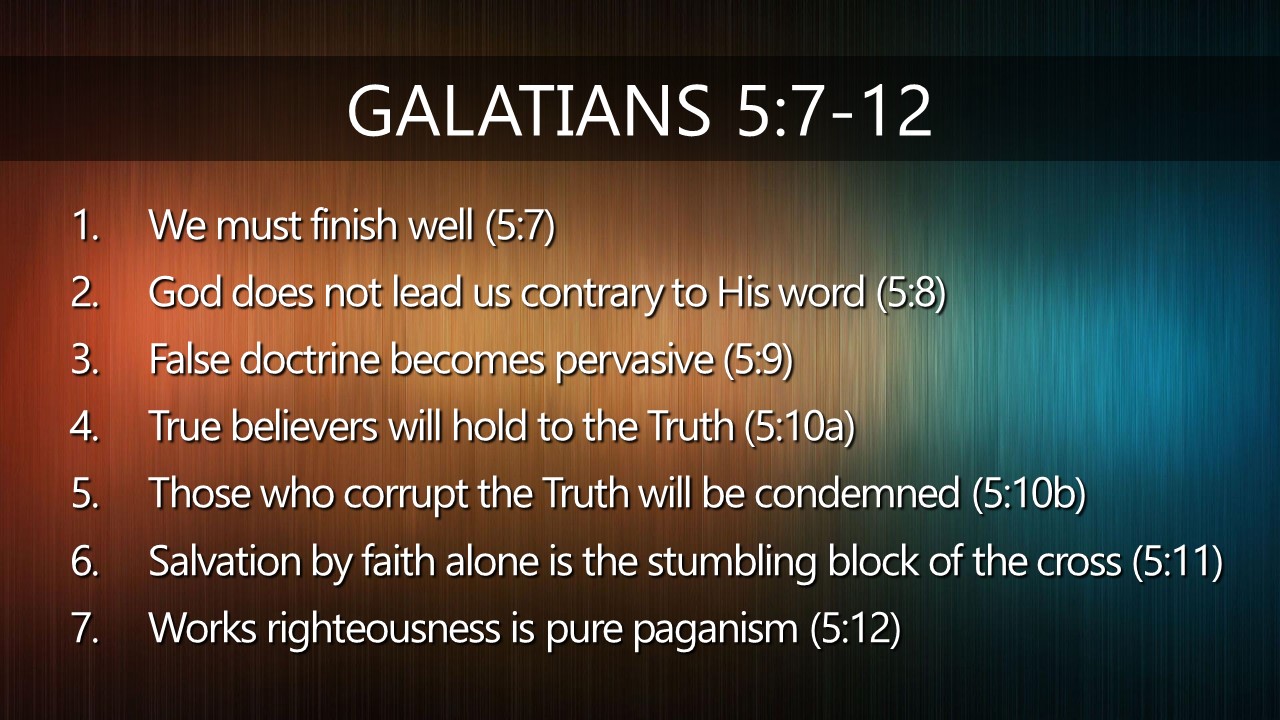
That’s part of what we were talking about in connection with God dealing with Israel as Sodom and Egypt. They’re going through all the rites of the Mosaic Law in Isaiah, and God says you’re trampling My courts. That’s defiling! You know we start to minimize the seriousness of these matters. There’s no mixing works and grace. No mixing works and grace, so Paul said the same thing to the Philippians and we don’t have time to go there, but in Philippians chapter, three he warned them, “beware of the false circumcision,” and he used a word there that means the mutilation. He doesn’t even use it as something connected. It’s false circumcision. Beware of the mutilation. He won’t even connect it to the significance of circumcision as given to Abraham as a sign of that covenant and then required under the Mosaic Law that connected to salvation and sanctification. It is an act of mutilation. The seriousness of it. All right let me summarize quickly with you what we’ve gone over this evening.
1. We must finish well.
That’s where Paul will pick up when we move on further. We must finish well. That’s the point. You were running well; what happened, why are you off track? If I meet people that used to attend Indian Hills, I ask them where they go. I met somebody here recently and talked to them. I said, that’s great that’s a church that is committed to the word and preaches the gospel. I’m glad to hear you’re there. I meet people and they sort of hang their head and say well, we’ve been going to—I say what are you doing there? Well our kids had friends and they wanted to go—I know, I know what you’re going to say, that’s not a church that teaches and I know that but—but what? This some kind of game, so you take your kids to where they teach error because they have friends there, take them to the playground. When you take them to church, take them to the truth. We must finish well and it starts with each of us individually.
2. God does not lead us contrary to His Word.
That’s verse 8. This persuasion does not come from Him who calls you. It takes all the emotion. You know, well what about this what about that does it agree with the word or doesn’t it. If it doesn’t, it doesn’t come from God. God doesn’t contradict Himself. We find excuses, well you know, I think they’re sincere I think they mean well. Well they’re good people and—they can’t teach error! They can’t promote error. Are relationships more important to us than truth? Jesus said, if you love your family more than me, you can’t be My disciple. He takes total commitment.
3. False doctrine becomes pervasive.
It’s like the leaven. It’s like a disease; a little bit can spread so we deal with it. We have tests to check and see because it spreads. That’s the way error is it becomes pervasive.
4. True believers will hold to the truth.
You know what Paul told the Corinthians. There must be divisions among you, so that those who pass the test may become evident. That’s part of the sifting process. That doesn’t mean everybody who leaves one bible believing church for another has abandoned the truth, but true believers will hold to the truth. They will stand with the truth. We are identified as people who live truth.
5. Those who corrupt the truth will be condemned.
There’s no middle ground again, and the truth we have is the word of God. It’s a revelation of His character, His Person; the God who cannot lie has spoken. Here we have truth.
6. Salvation by faith alone is the stumbling block of the cross.
Keep it clear. Salvation by faith alone is the stumbling block of the cross. I keep mentioning Roman Catholicism because they state it, the Council of Trent never changed. Anyone who says that salvation is by faith alone is anathema, so there’s no middle ground. Salvation by faith alone is the stumbling block of the cross. Paul said if I didn’t preach that I wouldn’t be persecuted. You know Rome allowed all kinds of religions but the problem was Paul said, there is only one true way to God, way to worship Him.
7. Works righteousness is pure paganism.
That’s the point of verse 12. Circumcision as a way to be righteous with God, to become more holy that’s no different than paganism. You might as well go all the way and identify with the worship of the goddess Cybele as we sometimes pronounce them, that goddess, yeah that involved castration. Go ahead and go all the way, you’re in paganism you might as well go in, all the way. Well, they’re not there. At least they believe this, at least that can be the danger, when the devil mixes truth in with his error and we look at the truth and say well at least, you know, they believe some of the truth like we do. That’s the problem. A little leaven leavens the whole lump. The devil didn’t put that truth in there, to help us grow, he put that truth in there, to lure us away. You know it’s like the bait you put on a hook. It’s not to satisfy the appetite of the fish, it’s to lure him and deceive him, so Paul continues the truth of the word of God. How blessed we are to have it.
Let’s pray together. Thank you Lord for Your word, for the riches that have been entrusted to us, a treasure that we are to guard. It’s what has been entrusted to our care. We are responsible. We are accountable to You. We are the church you’ve established in this place to be a pillar and support of the truth. May we be faithful to that truth, may we share it with those who do not know it. May we count it most precious and live in light of it, we pray in Christ’s name. Amen.